A professional workbench for turning real conditions into your own fair number.
Free account: Builder preview and 5 saved builds per UTC day · Pro or Sharp: Every dial and unlimited saved builds
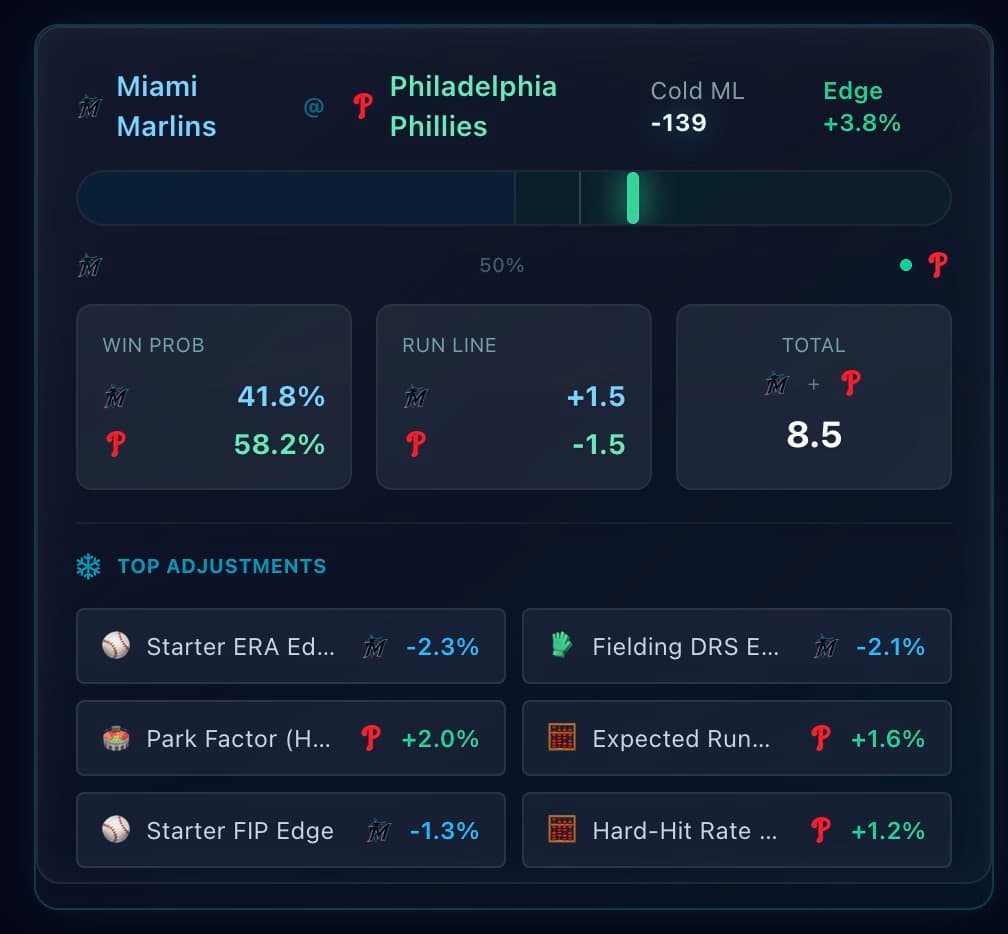
Captured pregame · Alcantara vs Nola, MIA @ PHI, 6:05 PM ETEvery number here is the output of the dials below it, not a posted price.
Your build, the Cold Line, and the market
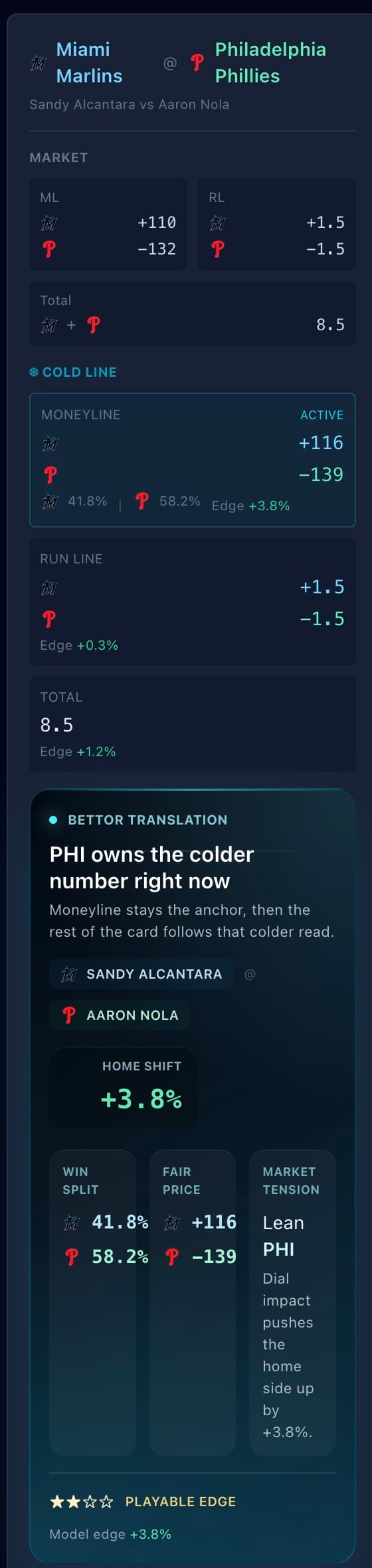
The build is only interesting next to something. The summary rail carries the market on top and the Cold Line under it, market by market, with the edge on each one — moneyline, run line, total. Then it says in a sentence which side owns the colder number and by how much your dials moved it.
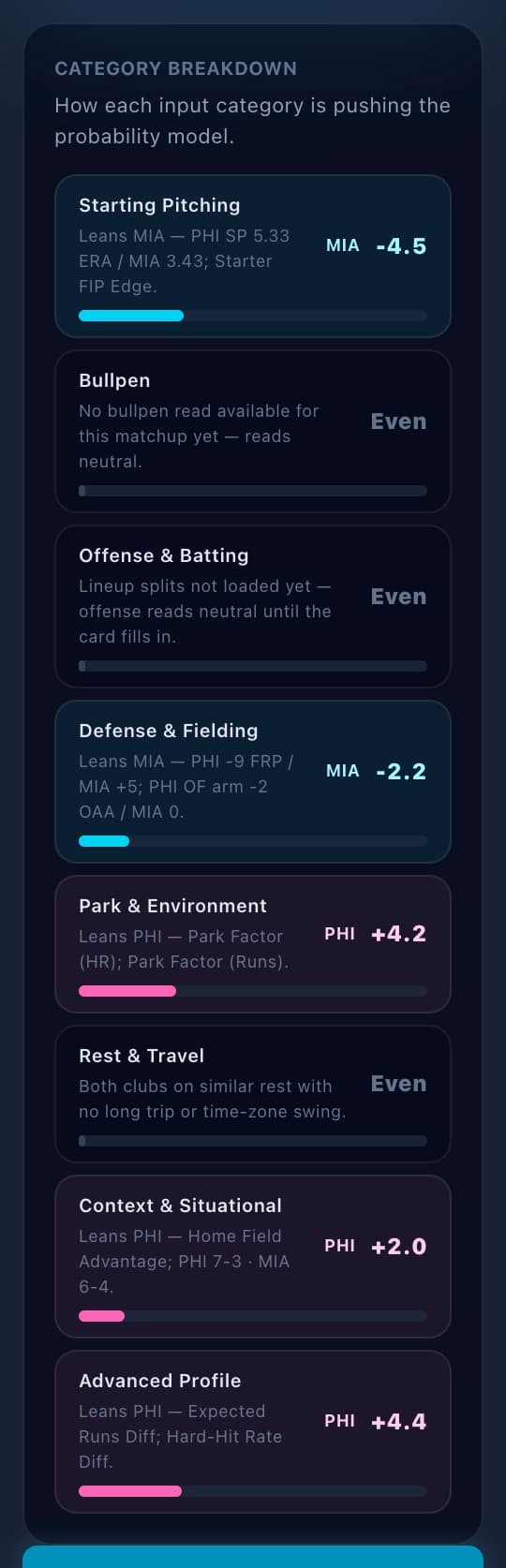
Captured pregame · MIA @ PHIMarket on top, Cold Line beneath it, edge on every market.Captured pregame · MIA @ PHIEight categories, each with the reason it moved and the size of the move.
That second panel is the part a pick sheet never gives you. Starting pitching pushes this game 4.5 toward Miami — Nola at 5.33 against Alcantara at 3.43 — while park, context and the advanced profile all push back toward Philadelphia, and the two sides very nearly cancel. Every line of that is written out with the number it came from. If you disagree with a category, you can find the dial that produced it.
The dials, and why each one is on the board
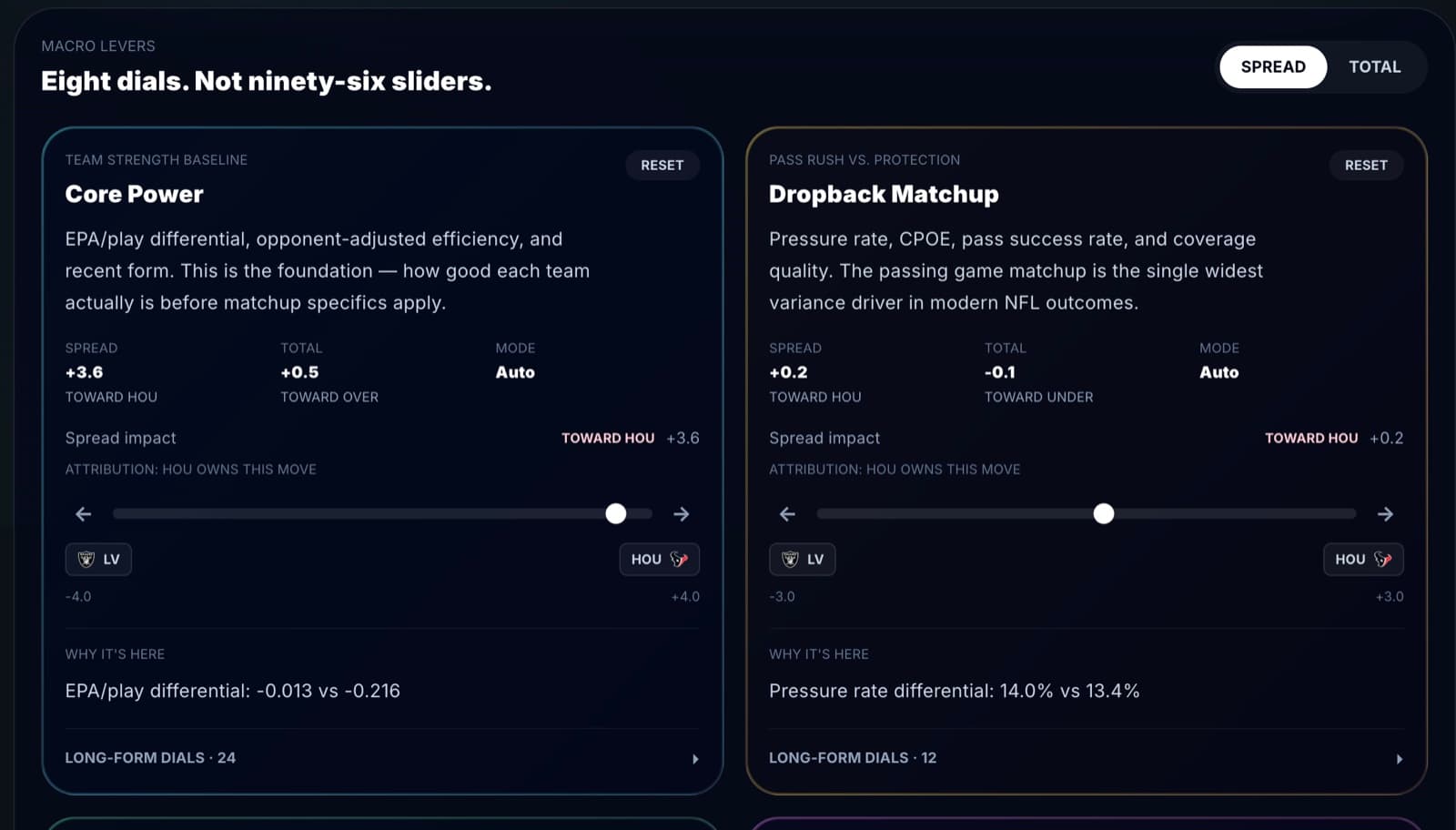
There are eight macro dials, not ninety-six sliders. Each one states what it measures, what it is currently doing to the spread and the total, whether it is on auto or you have taken it over, and — under “why it’s here” — the actual differential that set it. Every dial opens into its long-form inputs when you want to go further down.
Captured live · NFL workbench, HOU vs LVAuto sets every dial from the data. Taking one over is a deliberate act, and the desk records that you did.
Then run it
Building a number is half of it. The point is finding out where yours sits against everything else pricing the same game. Once your line is built, the matchup runs through the simulators on the same screen — the Cold Line engine, a Monte Carlo replay of the game, and a Poisson model built from statistical priors.
Each engine reaches its own number by its own route, and the market has one of its own. Your build sits beside all of them. Where they cluster, you have a number several independent methods agree on. Where yours is the outlier, that is the interesting part — either you are seeing something the models are not, or a dial needs another look. The comparison is the output.
Simulation counts are yours to set, and the replays are reported with the spread and total they averaged rather than a single confident figure.
What it is
The Cold Line Builder is a professional workbench for turning real conditions into your own fair number. Weather, travel, rest, injuries, scheme, and other situational factors go in. Your line sits beside the market.
This is not a tout ticket. You become the result.
Why it is there
The market posts first. That posted number is someone else's price, not an explanation of the game. The Builder exists so this analysis desk can price the same matchup from conditions instead of handing you a pick.
It is an analysis desk, not a handicapping service.
Why it is useful
A fair number you built is usable because you can see what moved it. When your line and the market disagree, the disagreement is inspectable — which conditions you counted, and which you left out.
You keep the reasoning. You become the result.
How it works
01Open a real matchup in the Builder.
02Read the conditions already on the desk: weather, travel, rest, injuries, scheme / situational factors.
03Keep what you believe. Change what you do not.
04Read your line beside the market. The workbench is the source of the number.